
Civil War By Alex Garland.
One of the cliches of your 40s in the 2020s is this: “I’m too young to feel this old” It is as if rather than the actual hours of graft and strife our parents went through, which got my generation, on a larger scale, a certain level of social support, education and accommodation has been eroded, and instead we are saturated with a weird digitised culture that has replaced our bricks and mortar with mindfulness and shanty towns. The best Civil War has to offer you have seen before, and the worst is filled with a passionate intensity that I can only put down to my age.
On a positive note, it does seem to want to start with the premise of “being ripped from the latest news headlines,” and given the ridiculous attack on Washington in the last election, this has a certain resonance. But this is frankly pretty twee, and for the most part, the film is 28 days without the zombies, which, given that we live in a post-demic world, is even weaker.
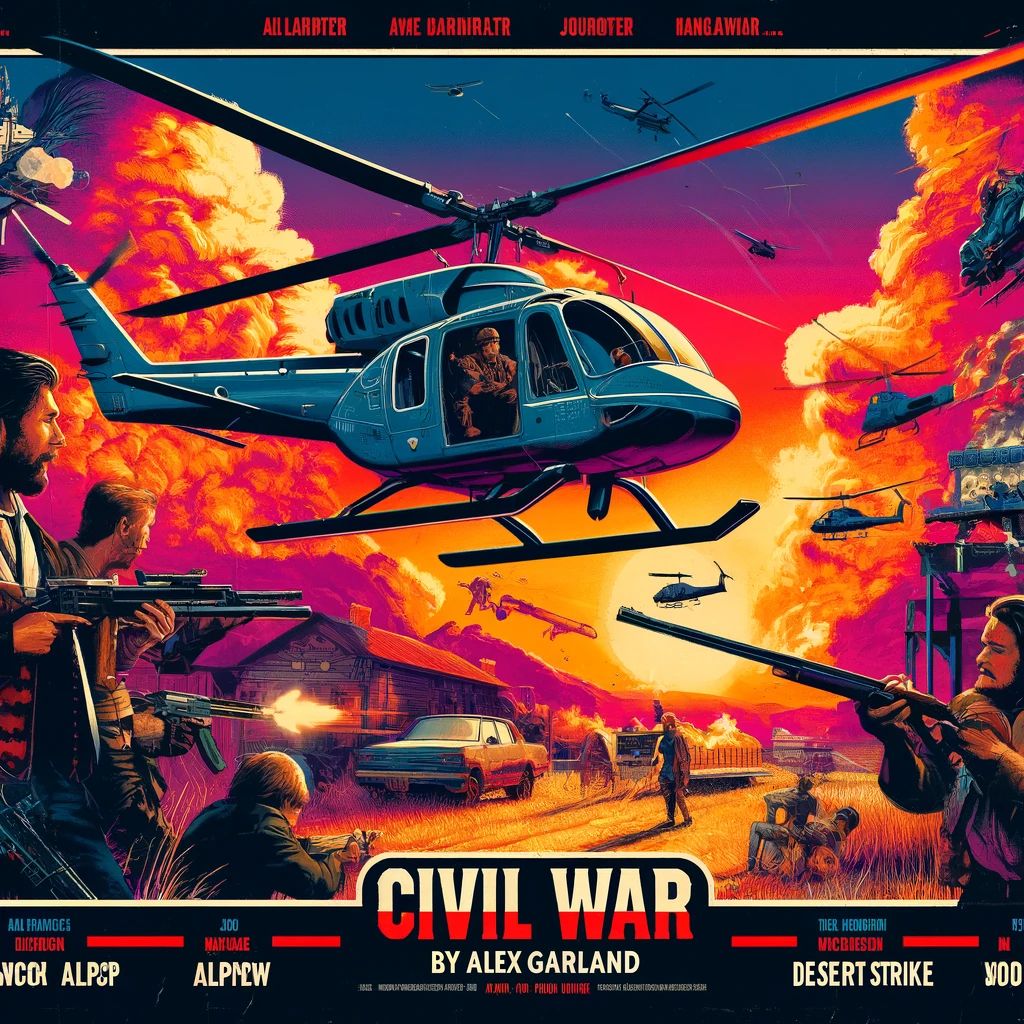
It’s diverting and entertaining on this level; the road trip crew is pretty much by the numbers: the young hot shot, the jaded veteran, the hyper male, and Obi Obi-Wan Kenobi get into the millennium falcon of truth and head down the yellow brick road to Washington to interview the president about his third term of office. On the way, they encounter scrapes, japes, and weird vignettes of how life could exist during a civil war. There’s a particular polish to the chopper porn and stylised mourning over realistic deaths and mise en scene. In that regard, you could have had a diverting and entertaining 80 minutes of bullets and broad strokes on Netflix and covered it all.
However, this is cinema, and with someone of Alex Garland’s reputation, there is a massive hole in this film, which is, in essence, ‘the black experience.’
Looking at the last election and only looking at the issues of race is retrograde. It reminded me of Alex Cox once saying how black people exist to die and be avenged in the last act. That’s not quite what happens, but it’s not far off. They exist to tell the characters and white viewers, “It’s ok, we know you are one of the good white people ” while bleeding and getting nothing for the attention they require but fragile white tears. It burns on one level to type that, but frankly, the absence is too meaningful in a film where it will be a significant plot point.
Nazis exist, they come into the frame, and then out again, hello we are the bad guys.,and then gone. However, no sense of Washington’s makeup and poverty in D.C. is covered. This is an A24 film, now right or wrong, that is a studio with a reputation for representation. I did not see that in this film. Do I amend it? Only sometimes. I’m easily pleased on one level. You stick a katana and a pair of stockings on a strong female lead, and I’m there in a shot. I’m a terrible male gaze. But if you’re going to make a film about this situation. Not being more direct is annoying. It could have been over stating the mark. I doubt it.
It’s a solid stylistic choice, but it may be old. I kept thinking Children of Men did this better. And perhaps it needed zombies. For those who have yet to see the films, though, maybe it’s the intro they need. And if this is the old guy telling people to check the back catalogue, that may not be a terrible thing.
 The Irish Indian Times.
Leave a comment